
AI Workflows vs. AI Agents: Understanding the Difference and Knowing When to Use Each
Introduction
Technical teams and implementation specialists increasingly need to understand the core differences between AI workflows and AI agents to make informed automation decisions. AI workflows rely on structured, rule-based logic and predefined decision trees, while AI agents operate autonomously with adaptive learning capabilities. Organizations should use workflows for processes requiring strict compliance and agents for scenarios involving dynamic problem-solving. Each technology plays a distinct role in enterprise automation strategies—from operational efficiency to intelligent decision-making. Choosing the right approach is essential for successful implementation and maximizing ROI.
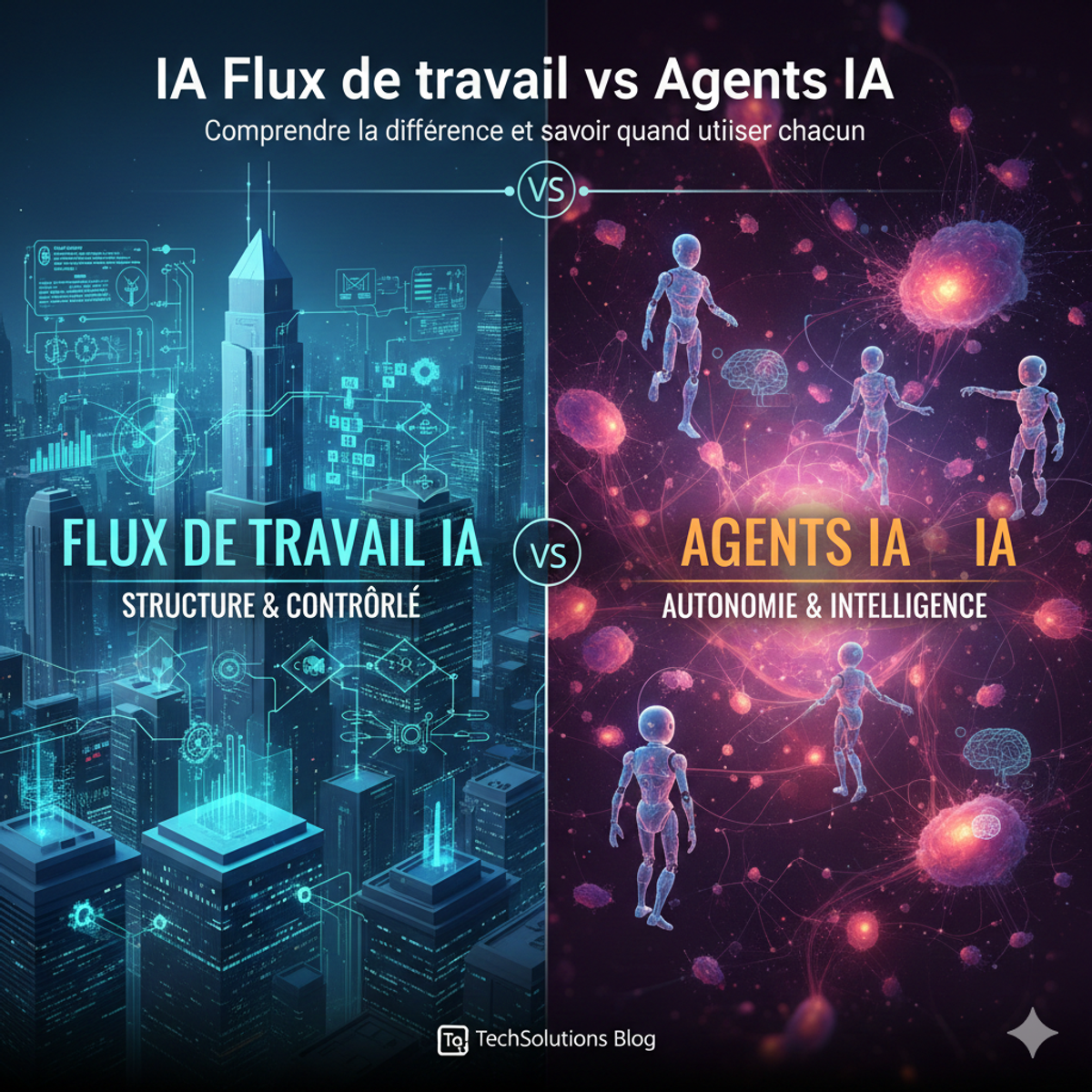
Understanding AI Workflows: Structure and Control
AI workflows are structured automation systems that follow predefined paths and decision trees. They execute tasks in a sequenced order based on specific rules and conditions. Unlike autonomous systems, workflow automation maintains strict control over every step of the process.
Key characteristics include sequential processing, conditional logic frameworks, and built-in human supervision points. Their ability to integrate with existing enterprise systems ensures smooth data flows and end-to-end process continuity.
AI workflows excel in environments requiring predictable outcomes and clear auditability. They offer full transparency into decision-making, and organizations can easily update rules as business requirements evolve. Their structured nature also simplifies troubleshooting and maintenance.
These systems perform best when processes have clear start and end points. They handle exceptions through predefined error-handling protocols. AI workflows also enforce regulatory compliance by ensuring consistent execution patterns.
Key Components of AI Workflow Architecture
The technical foundation of AI workflow tools includes several critical elements:
- Triggers initiate processes based on specific events or conditions.
- Decision nodes evaluate data against predefined criteria to determine the next action.
- Action executors perform the tasks defined in the workflow sequence.
- Error-handling protocols manage exceptions and direct issues to appropriate resolution paths.
- Monitoring dashboards offer real-time visibility into performance and potential bottlenecks.
Understanding AI Agents: Autonomy and Intelligence
AI agents function as autonomous systems capable of independent decision-making without constant human oversight. They learn from interactions and environmental feedback to improve their performance over time. Unlike rigid workflow automation, agents adapt their strategies based on changing conditions and new information.
The core difference lies in their problem-solving and decision-making approach. Agent-based systems can adjust their behavior based on outcomes and environmental shifts. They use predictive capabilities to anticipate needs and proactively address issues.
AI agents excel in dynamic environments where conditions frequently change. They handle ambiguous situations that don’t fit predefined rules. This flexibility enables continual process optimization without human intervention.
Agents demonstrate goal-oriented behavior and can work independently or collaboratively with other agents to accomplish complex tasks. Intelligent agent-based automation allows organizations to manage unpredictable scenarios effectively.
How AI Agents Make Decisions
AI agents rely on machine learning models to analyze data and make informed decisions. Natural language processing enables them to understand and respond to human communication. Predictive analytics helps anticipate future scenarios and prepare appropriate actions.
Goal-oriented behavior drives agents to optimize their actions toward specific outcomes. Environmental perception allows them to gather and process information from multiple sources simultaneously. Adaptive learning enables continuous improvement based on experience and feedback.
Agent-based workflows often use reinforcement learning to refine decision-making processes. They can detect patterns in data that humans may overlook. As agents accumulate knowledge and experience, intelligent automation becomes increasingly sophisticated.
Technical Comparison: Workflows vs. Agents
Implementation Complexity
- Workflows: simpler to implement, require fewer computational resources.
- Agents: need more processing power for learning and autonomous decision-making.
Maintenance
- Workflows: require periodic rule updates and condition changes.
- Agents: require continuous training data and model refinement.
Scalability
- Workflows: scale predictably with clear resource requirements.
- Agents: may require additional compute resources as complexity grows.
Integration
- Workflows: integrate easily via standard APIs and data formats.
- Agents: may require custom integration to support dynamic behavior patterns.
Decision-Making Speed
- Workflows: fast, rule-based decisions along predefined paths.
- Agents: may take longer due to analysis and learning, but deliver more nuanced results.
Error Handling
- Workflows: structured exception handling with predetermined resolution paths.
- Agents: adaptive recovery strategies based on context and historical outcomes.
Use Cases: When to Choose AI Workflows
AI workflows are ideal for processes requiring strict compliance, predictable outputs, and clear audit trails.
Examples include:
- Financial institutions using structured workflows for loan approvals and regulatory reporting.
- Multi-step approval chains, such as invoice processing or contract reviews.
- Legacy system integrations in sectors like manufacturing (quality control, production planning).
- Healthcare workflows, including patient intake and medical record management.
Workflows ensure consistent execution and adherence to regulatory or procedural standards.
Use Cases: When to Choose AI Agents
AI agents shine in scenarios requiring adaptability, contextual understanding, and intelligent decision-making.
Common applications include:
- Customer service automation where interactions require contextual reasoning and personalized responses.
- Dynamic resource allocation, such as cloud platforms adjusting compute resources in real time.
- Predictive maintenance, where agents analyze sensor data and environmental conditions to prevent equipment failures.
- Complex problem-solving, such as supply chain optimization with changing market conditions.
Agents learn, improve, and adapt—making them suitable for unpredictable, rapidly changing environments.
Hybrid Approaches: Combining Workflows and Agents
Advanced automation strategies increasingly combine structured workflows with autonomous agents.
Hybrid systems offer:
- Workflow-based governance with agent-driven dynamic decision-making.
- Structured handling of routine tasks, with agents managing exceptions or complex decisions.
- Orchestration models that coordinate workflow components and agent-based systems.
- Integrated architectures supporting both structured data flows and dynamic agent communication.
This approach maximizes both efficiency and adaptability, enabling organizations to benefit from the strengths of both paradigms.
Implementation Strategy for Hybrid Systems
Designing hybrid architectures requires careful planning:
- Select workflow tools for structured processes and agent components for dynamic decision points.
- Define integration models that specify how workflows and agents communicate and share information.
- Establish governance frameworks outlining the boundaries of agent decision-making.
- Implement monitoring strategies that track both workflow efficiency and agent learning progress.
The monitoring layer should provide visibility into both structured processes and adaptive system performance.
Conclusion and Next Steps
The choice between AI workflows and AI agents depends on organizational needs and process requirements. Workflow automation excels in structured environments requiring strict compliance, predictable results, and strong auditability. AI agents thrive in dynamic scenarios requiring adaptive decision-making and continuous learning.
A successful automation strategy requires aligning technological capabilities with business objectives. Organizations should assess process complexity, required autonomy levels, and available resources before making technology decisions.
The future of enterprise automation will likely rely on hybrid approaches that combine both technologies. Agent-enhanced workflows represent an evolution toward more sophisticated automation strategies. Organizations can start with structured workflows and gradually introduce agent components as expertise and confidence grow.
We invite you to share your experiences implementing AI workflows and agents in the comments. Your insights into specific use cases and challenges help strengthen collective knowledge within the automation community. Contact our team for personalized guidance in developing your automation strategy and selecting the right technologies for your organization’s unique needs.